


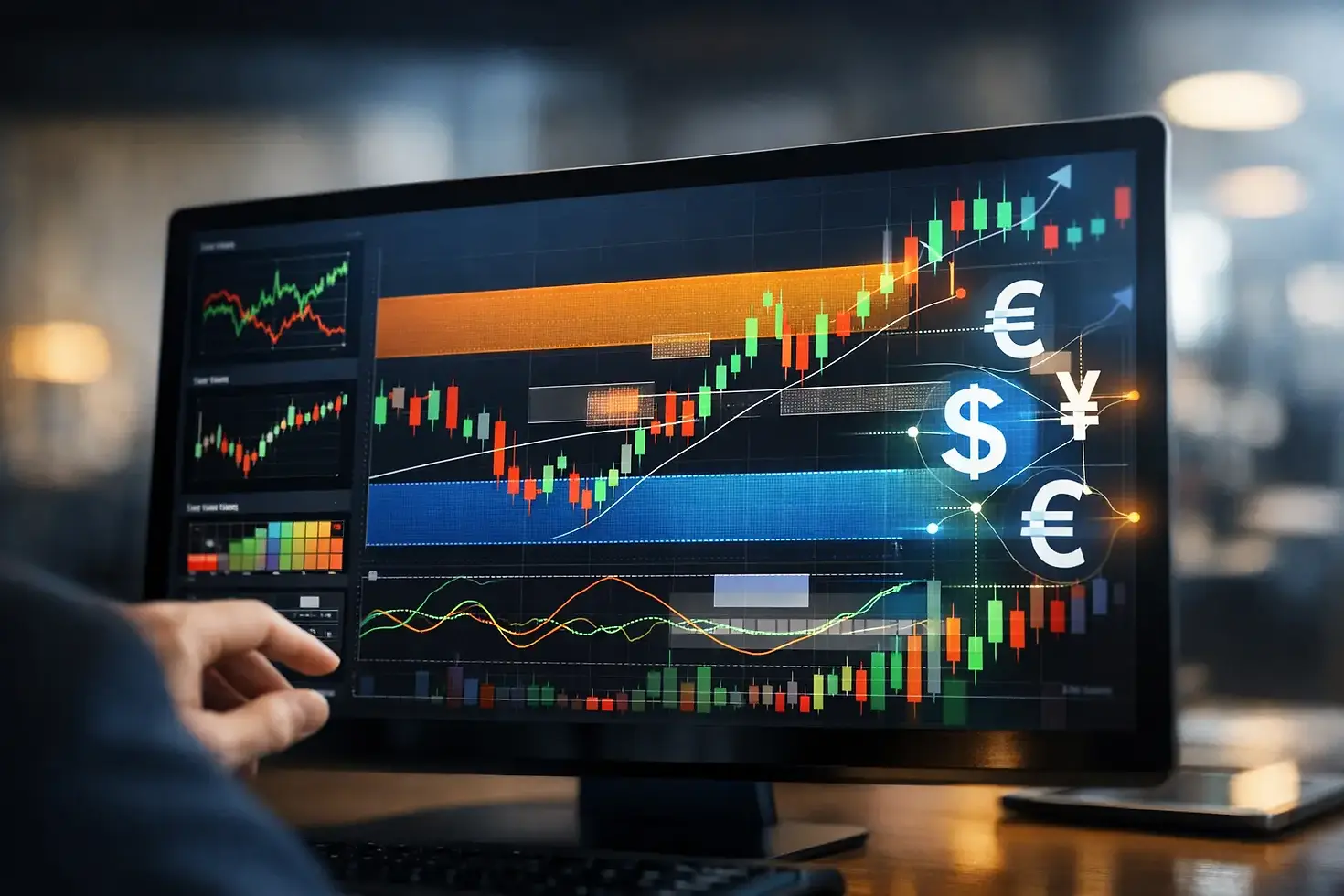
AI Forex Tools Trend: What Traders Should Watch

Price can run a clear pool of liquidity, displace sharply, and return to a fair value gap within minutes. The AI forex tools trend promises to help traders identify this sequence faster. That can be useful, but speed is not the same as understanding. A tool can highlight a pattern; it cannot remove the need for context, patience, risk control, and a written trading plan.
For retail traders, the most valuable use of AI is not handing control of every trading decision to software. It is reducing repetitive work so you can spend more time judging market structure, session behaviour and whether a setup genuinely meets your rules.
What is driving the AI forex tools trend?
AI tools are appearing across charting, market research, trade journalling and automation. Some scan multiple currency pairs for predefined conditions. Others summarise economic calendars, tag screenshots in a journal, or turn plain-English prompts into indicator settings and backtesting ideas.
Their appeal is understandable. Forex markets produce a constant flow of price data, and traders often struggle with information overload rather than a lack of indicators. An AI-assisted workflow can organise observations, flag potential areas of interest and expose habits that are difficult to see after a stressful trading week.
The limitation is equally important. Most AI tools learn from historical data, programmed rules or probability-based language models. Markets are adaptive. A model may identify a repeated formation without knowing whether price is approaching higher-timeframe supply, reacting to a major scheduled release, or simply ranging in low-liquidity conditions.
This is why traders should treat AI as an assistant, not an authority. It can make preparation more efficient. It cannot create a reliable edge from vague rules.
Where AI can help Smart Money Concepts traders
Smart Money Concepts are contextual by nature. Liquidity, market structure, order blocks, fair value gaps, break of structure and change of character mean different things depending on location and timing. Even so, several parts of the process can be supported well by technology.
Screening and chart preparation
Scanning is one of the strongest applications. A tool may alert you when price reaches a previous daily high or low, trades into a marked supply or demand zone, or creates a possible break of structure after a liquidity sweep. This does not mean the alert is a trade. It means the pair deserves your attention.
For example, consider GBP/USD during the London session. An alert may show that price has swept the Asian-session low and returned into a bullish fair value gap on the 15-minute chart. Before taking any action, the trader still needs to assess the higher-timeframe dealing range, whether downside liquidity has genuinely been taken, and whether displacement confirms buyers are taking control.
Used properly, the tool prevents missed opportunities without encouraging impulsive entries. Used badly, it becomes another source of alerts that pulls attention away from a focused watchlist.
Journalling and performance review
AI can be particularly useful after the trade. Many traders record entry, stop loss and result, but fail to record why they entered, what the market context was, and whether they followed their own process. That leaves them with statistics but little practical feedback.
A journal assistant can sort trades by session, setup type, pair, direction and outcome. It may reveal that your best executions occur after a liquidity sweep and change of character during London, while your weakest trades are counter-trend entries taken late in New York. This is valuable because it directs review towards behaviour rather than emotion or isolated wins and losses.
The quality of the output depends on the quality of the inputs. If every losing trade is labelled “bad market” and every winning trade is labelled “good setup”, no tool can produce an honest diagnosis. Use consistent tags and include chart screenshots before and after entry.
Turning rules into repeatable checks
A trader with a clear model can use AI to turn that model into a pre-trade checklist. Rather than asking, “What should I trade?”, ask structured questions: Has external liquidity been taken? Is price at a higher-timeframe point of interest? Has lower-timeframe structure shifted? Is there enough room to the next opposing liquidity target for the planned risk?
This protects the method. The tool is working from your criteria rather than inventing criteria for you. It also makes it easier to identify the difference between a valid setup that loses and an avoidable rule breach. Losses are part of trading; undisciplined execution is a separate problem.
What AI cannot reliably decide for you
The most dangerous marketing around trading technology implies that more data automatically produces better decisions. It does not. Forex price action contains ambiguity, and SMC analysis requires traders to accept that ambiguity instead of hiding it behind confident-looking outputs.
An algorithm may draw an order block wherever the chart meets a technical definition. A skilled trader must decide whether that order block caused meaningful displacement, sits at an appropriate point in the range, and aligns with the prevailing narrative. A zone is not significant merely because a rectangle appears on the chart.
Likewise, sentiment summaries can be useful background research, but they cannot determine whether a specific entry is valid. Major news can create rapid expansion, false breaks and wider spreads. During those conditions, a technically attractive setup may not suit your plan or your risk tolerance.
No tool can decide your position size responsibly without accurate account parameters, stop distance, maximum daily risk and a clear understanding of the conditions you are trading. Automation can calculate. It cannot take responsibility for the result.
How to assess an AI forex tool before using it
Start with the problem you want to solve. If you repeatedly miss pre-defined levels while at work, an alerting tool may help. If you overtrade after losses, a journal and rule-checking workflow may be more useful than another indicator. A vague desire for “better signals” usually leads to clutter rather than progress.
Then test the tool in a controlled way. Run it alongside your existing process for several weeks, preferably in replay or on a demo environment where appropriate. Record whether it improves preparation, execution quality or review. Do not judge it simply by whether its highlighted ideas would have won on a few charts.
Check how transparent its logic is. Tools based on clearly described market-structure rules are easier to evaluate than black-box systems that produce a buy or sell label with no reasoning. If you cannot explain why an alert appeared, you cannot know when it is likely to fail.
Finally, consider the operational details. Does the tool use delayed data? Can alerts be tailored to your trading sessions? Does it encourage excessive chart-watching? Does it store trading information securely? The best tool is often the one that does one narrow job reliably and fits your routine.
A practical AI-assisted workflow
A disciplined workflow begins before the market moves. Mark higher-timeframe liquidity, supply and demand, and the boundaries of the current dealing range. Note any scheduled events likely to affect volatility. An AI research or alert tool can help organise this preparation, but the levels and bias should remain traceable to your own analysis.
During your chosen session, wait for price to reach an area that matters. If an alert fires, move through your rules: liquidity sweep, displacement, change of character, retracement into a fair value gap or order block, then a defined invalidation point. If one element is missing, there is no obligation to trade.
After the session, log both trades and passed opportunities. Ask whether the tool saved time, distracted you, or helped you follow rules more consistently. Over a meaningful sample, keep only the features that improve decision-making. Remove the rest.
The real edge is structured judgement
The AI forex tools trend will continue because traders want faster analysis and cleaner routines. That is reasonable. The opportunity is to use technology for what it does well: sorting information, monitoring levels, calculating quickly and revealing patterns in your own behaviour.
Your edge still comes from reading price in context, waiting for confirmation, managing risk and executing the same process when the previous trade won or lost. Build the skill first, then let tools support it. Continue developing that structured approach through Forex Fire’s educational resources, chart breakdowns and trading community.


Comments