


Forex Risk Management Guide for Day Traders

Updated: May 6
One bad trade rarely ruins a trader. A bad risk model does. If you are serious about consistency, this forex risk management guide matters more than your entry pattern, your favourite pair, or the indicator you keep tweaking every weekend. Traders do not usually fail because they never find a setup. They fail because they size too big, move stops when pressure hits, or treat survival like an optional extra.
The hard truth is simple. Risk management is what keeps you in the game long enough to let skill compound. It is also what separates a trader chasing adrenaline from a trader building something real. If you want to pass a prop firm challenge, protect capital, and trade with confidence rather than hope, you need rules that still work when your emotions do not.
What a forex risk management guide should actually teach you
A proper forex risk management guide is not just a reminder to use a stop loss. It should help you answer the questions that matter before you place a trade. How much am I willing to lose? Where does the trade idea become invalid? Is the position size correct for this stop distance? How much total exposure do I already have on correlated pairs?
Most traders think risk starts after they enter. It starts before the trade exists. The decision to trade is a risk decision. The pair you choose, the session you trade, the news you ignore, and the target you set all shape your risk profile.
That is why good risk management is not defensive in a weak sense. It is offensive in a professional sense. It gives you control. It stops one mistake from becoming a week of damage. It keeps your mind clear enough to execute the next opportunity properly.
Start with fixed risk per trade
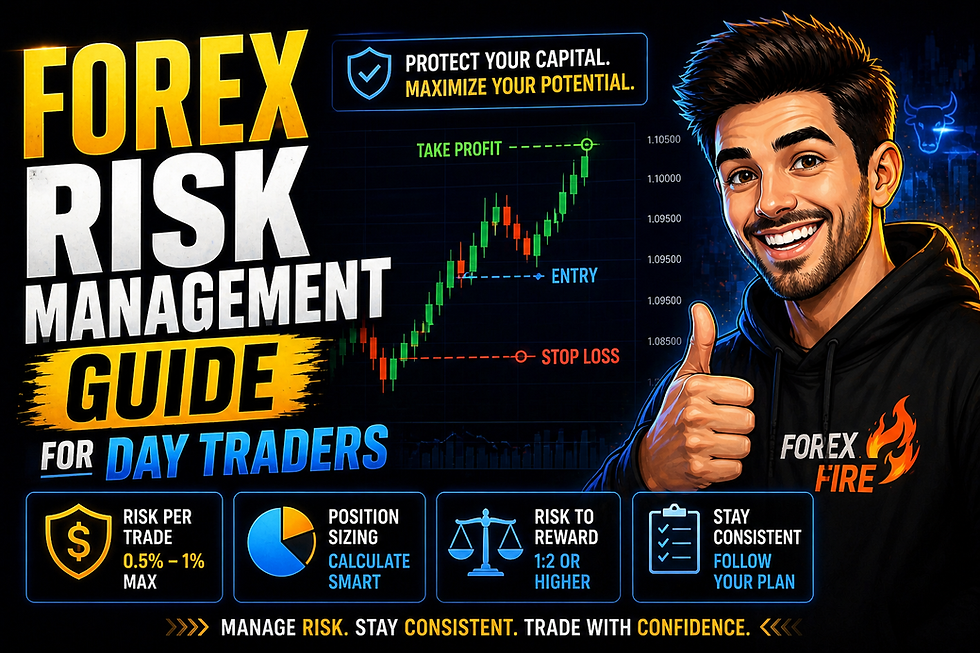
If your position size changes based on emotion, your account will eventually reflect it. The cleanest starting point is fixed percentage risk. For many retail traders, that means risking 0.25 per cent to 1 per cent per trade, depending on experience, account size, and volatility.
There is no magic figure that suits everyone. A newer trader trying to build discipline may need to stay near the lower end. A more experienced trader with a proven edge might handle 1 per cent sensibly. The point is consistency. You should know your risk before you click buy or sell, not after the market moves against you.
This is especially important for day traders and funded traders. Prop firm rules often punish recklessness faster than the market does. A trader who risks 2 to 3 per cent on a single scalp may feel aggressive and confident right up until one losing streak puts the challenge out of reach.
Position sizing is where discipline becomes real
A stop loss without proper sizing is not risk management. It is decoration.
Your lot size must be built around three things: account size, percentage risk, and stop loss distance. If your stop is wider because the market structure demands it, your position must be smaller. If you force a larger lot because you want a bigger payday, you are no longer following a plan. You are gambling with better branding.
This is where many traders trip themselves up. They find a clean institutional-style setup, place a logical stop, then oversize because the setup looks strong. Strong setups still lose. A good process accepts that fact before the trade begins.
The strongest traders are not the ones who feel no fear. They are the ones who remove unnecessary decisions from live execution. Position sizing should be mechanical.
Stop losses need logic, not wishful thinking
Your stop loss should sit at the level that proves the trade idea wrong, not at the level that feels financially comfortable. There is a difference.
If your setup is based on a liquidity sweep and shift in structure, the stop needs to respect that structure. If your trade only works while a key low holds, then that low matters. Placing a tight stop in a random spot just to increase position size usually creates a worse result - more stop-outs, more frustration, and more revenge trading.
Of course, wider stops are not always better either. A stop that is too wide can kill your reward-to-risk ratio or force such a small size that the trade becomes inefficient. That is where judgement comes in. Not every setup is worth taking. Some are valid on paper but poor in practice because the risk profile is weak.
Reward-to-risk matters, but context matters more
Traders love quoting fixed ratios like 1:2 or 1:3 as if they are universal laws. In reality, it depends on your strategy.
A scalp trader taking partials at nearby targets may not need every trade to reach 1:3. A higher-timeframe intraday trader might demand more room and larger returns. What matters is whether your average winner, average loser, and win rate work together over a meaningful sample.
Do not force a target that the market is unlikely to reach just because a spreadsheet says the ratio looks better. Equally, do not cut trades early every time price hesitates and then wonder why your edge never pays. Risk management includes exit management. You need a model that suits the way you trade, not a rule copied from social media.
Correlation can quietly double your risk
This is one of the most overlooked areas in any forex risk management guide. If you are long GBPUSD, long EURUSD, and short the dollar index in spirit, you may think you have three trades. In reality, you may have one idea expressed three times.
Correlated exposure can hurt fast when the market turns. The same applies to gold and dollar-sensitive pairs, or indices during high-volatility news conditions. If several positions are likely to react to the same driver, your total account risk may be far higher than it appears.
Professional thinking means looking at portfolio risk, not just trade risk. You do not need ten positions if they all tell the same story.
Daily loss limits protect you from yourself
Most trading damage does not happen on the first loss. It happens on the third or fourth trade after your mindset slips.
A daily loss cap gives you a hard line. That might be 2 per cent, or two full losing trades, or any limit that suits your account and strategy. Once you hit it, you stop. No exceptions, no heroic recovery attempt, no telling yourself the next setup is the one that gets it all back.
This rule feels restrictive until the day it saves your week. Good traders respect the emotional side of execution. They know fatigue, frustration, and overconfidence all distort judgement. A daily stop protects capital and decision-making at the same time.
News risk is real even for technical traders
You can have the cleanest chart in the world and still get run over by a major release. Interest rate decisions, CPI, NFP, and central bank commentary can blow through structure and spread assumptions in seconds.
That does not mean you must avoid every scheduled event. It means you must decide your approach in advance. Some traders stand aside completely. Others reduce size or wait for the post-news reaction. What matters is that you treat news as part of the risk plan, not an inconvenience.
If you trade around high-impact events, be honest about slippage and spread expansion. Your backtest may look tidy. Live conditions often do not.
The psychological side of risk is where consistency is won
Plenty of traders know the maths and still break their rules. That is because risk management is not just technical. It is behavioural.
If you keep moving stops, increasing size after losses, or taking marginal setups because you feel behind, the issue is not a lack of information. It is a lack of process ownership. You need rules you can actually follow under pressure. That may mean risking less, trading fewer sessions, or narrowing your playbook until discipline becomes repeatable.
This is also why community matters. Trading alone makes it easier to justify bad habits. Trading with structure, accountability, and experienced guidance makes it harder to drift. At Forex Fire, that team-first mindset is part of what helps traders sharpen execution and stay focused on long-term growth rather than short-term emotion.
Build your own forex risk management guide into a routine
The best risk plan is the one you use every single session. Before each trade, check the same core factors. What is my setup? Where is invalidation? What percentage am I risking? Is there nearby news? Am I stacking correlated positions? Have I already taken enough damage for the day?
Then review your data weekly. Look at where losses came from. Was it poor timing, oversized positions, impatience, or taking trades outside your model? A good journal exposes whether your problem is strategy quality or risk discipline. Those are not the same thing, and the fix is different.
If you want to grow in this game, stop treating risk management like the boring bit that sits before the exciting part. This is the exciting part. This is how serious traders stay alive long enough to become dangerous.
Keep learning with Forex Fire on YouTube: https://www.youtube.com/@ForexFire
Follow on Facebook: https://www.facebook.com/john.a.docherty
Join now and take advantage of our 6month and annual super saver deal: https://join.forexfiremembers.com/
Your next level in trading is not hidden in a secret setup. It is built through controlled risk, repeated well.


Comments