


How to Backtest Forex Strategy Properly

Updated: May 6
Most traders do not lose because they lack effort. They lose because they trust a strategy they have never properly tested. If you want to learn how to backtest forex strategy ideas with real confidence, you need more than a few chart screenshots and a lucky week. You need a process that shows whether your edge is real, repeatable and worth risking capital on.
Backtesting is where serious trading starts. It helps you see how a setup behaves across different market conditions, how often it wins, how deep the drawdowns get and whether your rules are actually clear enough to follow. For day traders, scalpers and anyone preparing for a prop firm challenge, that matters. Confidence built on data is far stronger than confidence built on hope.
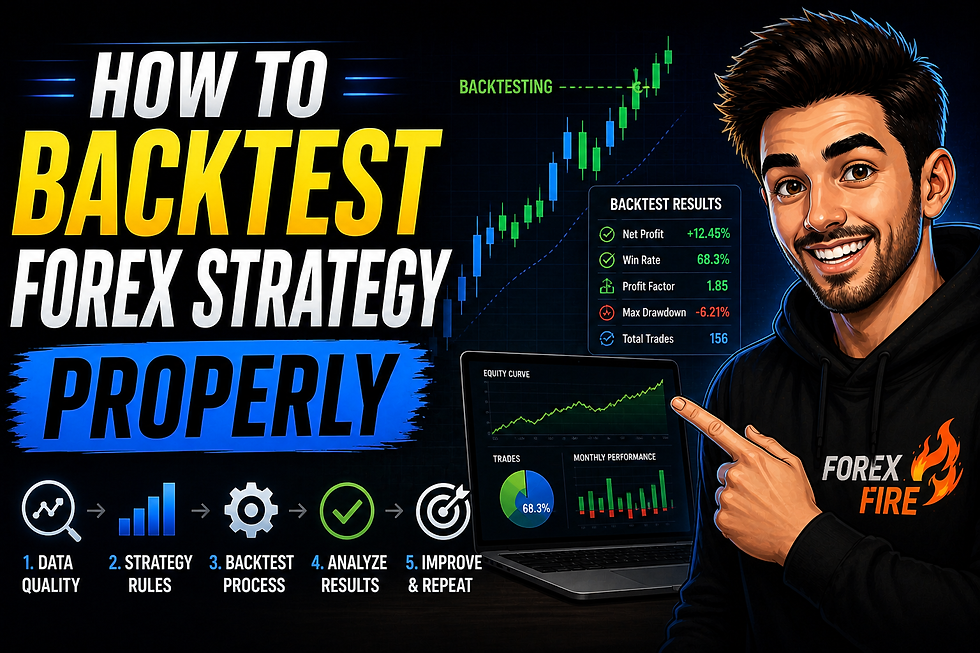
What backtesting actually does
Backtesting means applying your trading rules to historical price data to see how the strategy would have performed in the past. The key phrase there is trading rules. If your setup is vague, your backtest will be vague too.
A proper backtest is not about proving that your strategy works. It is about trying to find out where it breaks. That shift in mindset changes everything. You stop hunting for perfect win rates and start measuring whether the strategy has a genuine edge after losses, bad sessions and periods where the market is not clean.
This is especially important in forex because market conditions change. London session movement is different from New York chop. EUR/USD does not behave exactly like XAU/USD. News volatility can distort entries, spreads and stop placement. A strategy that looks brilliant in one narrow sample can fall apart the moment conditions change.
How to backtest forex strategy step by step
The first job is to define your strategy with enough detail that another trader could follow it without guessing. That means your entry, stop loss, take profit, risk per trade, trading session, market conditions and any filters all need to be written down. If you say you enter on a break and retest, what counts as a valid break? How close does price need to retest? What invalidates the setup? If you cannot answer those questions, you are not ready to test.
Once the rules are clear, choose the market and timeframe. Keep this focused. Do not test six pairs, gold and indices all at once if you are still refining the model. Start with one instrument and one timeframe so the results mean something. If your strategy is built for intraday execution, test it in the session you would actually trade.
Then decide how much historical data to use. In most cases, a few weeks is not enough. You want enough trades to reveal patterns, not just enough trades to make yourself feel good. For a lower timeframe strategy, that may mean several months of data. For a higher timeframe model, it may mean a year or more. The goal is not to chase an exact number. The goal is to collect a sample large enough that one hot streak does not distort the picture.
Now run the test trade by trade. Move through the chart candle by candle, not by scrolling ahead and then pretending you did not see the future. Record each setup exactly as it appears. Entry price, stop loss, target, result, risk-to-reward and any notes about context should all go into your journal or spreadsheet.
That final part matters more than many traders realise. If you only record wins and losses, you miss the deeper lesson. Notes help you spot whether your best trades happen at specific times, after certain price delivery patterns or only when volatility is above average. This is where a strategy starts becoming a system.
What to measure beyond win rate
A lot of traders obsess over win rate because it feels simple. But win rate alone tells you very little. A strategy can win 70 per cent of the time and still lose money if the losses are much larger than the winners. Another strategy can win only 40 per cent of the time and still be excellent if the reward outweighs the risk.
Look at net return, average reward-to-risk, maximum drawdown and expectancy. Expectancy is one of the most useful figures because it shows what you can expect to make or lose per trade over time. It gives you a realistic picture of the edge instead of an emotional one.
You should also track losing streaks. This is not just a numbers exercise. It is a psychology exercise. If your backtest shows that six consecutive losses are normal for your strategy, then you know that a run of losses does not automatically mean the strategy is broken. That knowledge can stop you sabotaging yourself in live conditions.
Common mistakes that ruin a backtest
The biggest mistake is changing the rules halfway through. Traders often start with one model, hit a rough patch, then quietly adjust the criteria to improve the results. That creates fantasy data. If you want to change the rules, stop the test, rewrite the strategy and start again.
Another mistake is ignoring spread, slippage and session conditions. Forex trading is not frictionless. A scalp strategy that looks brilliant on static chart data can become mediocre once real execution costs are considered. The lower the timeframe, the more this matters.
There is also the issue of cherry-picking. Some traders unconsciously choose the cleanest periods to test because they already know those market conditions suit their setup. A proper backtest needs a broad enough sample to include ugly price action as well as the textbook moves.
Then there is over-optimisation. This happens when you tune the strategy so tightly to past data that it fits historical price beautifully but has no flexibility in live markets. If your model only works with microscopic rule adjustments on one pair and one exact period, be careful. Markets do not pay you for curve-fitting.
Manual or automated backtesting?
It depends on your strategy and your skill level. Manual backtesting is brilliant for discretionary traders because it trains the eye. You learn market structure, timing and context while testing. You also build pattern recognition, which is invaluable if your entries depend on reading price action rather than a strict coded rule set.
Automated backtesting can be faster and more objective, but only if the strategy can be coded accurately. For highly mechanical systems, that can save time and produce large sample sizes quickly. For more discretionary smart money or institutional-style concepts, automation may miss the nuance that makes the setup work.
For most developing traders, manual backtesting is the better place to start. It is slower, but that is often the point. Slower testing forces clarity.
How to know if your strategy is worth trading live
A good backtest does not need to look perfect. It needs to look believable. You want a strategy with a positive expectancy, manageable drawdown and rules you can execute consistently without second-guessing every decision.
You also need to ask whether the strategy suits you. A profitable model on paper is useless if it requires you to sit at the screen during hours you cannot trade, or if the drawdowns are too aggressive for your psychology. There is no prize for choosing a strategy that makes you abandon your plan after three losing days.
This is where many traders level up. They stop asking, “Is this the best strategy?” and start asking, “Is this a strategy I can trade well?” That question leads to consistency.
From backtest to forward test
Once your backtest shows promise, the next step is forward testing on demo or very small risk. This is where you check whether your historical rules hold up in live conditions, with real spreads, timing pressure and your own execution habits.
If the forward test results are close to your backtest, that is a strong sign your process is solid. If they are wildly different, something is off. Usually it is either the rules were too subjective, the execution is inconsistent or the market conditions have shifted.
Trading growth comes from this cycle - test, refine, forward test, review. That is how you build an edge with substance instead of chasing one strategy after another.
If you are serious about becoming a more structured trader, backtesting is not optional. It is the work that separates gamblers from traders who know what they are doing. Put the hours in now, and you give yourself a real chance to trade with discipline when money is on the line.
We learn together, we trade together, we win together.
Watch more on our YouTube channel:
Follow us on Facebook:
Join now and take advantage of our 6month and annual super saver deal:


Comments